Still Using DeploymentConfig? Here's Why It's Time to Move On
Learn OpenShift 4

If you’ve been running OpenShift for a few years, you almost certainly have DeploymentConfigs somewhere in your cluster. They work fine. They’ve always worked fine.
But they’ve been officially deprecated since OpenShift 4.14, and it’s worth understanding why. Not just because Red Hat says so, but because the underlying technology has genuinely moved on.
Some context. When OpenShift 3 shipped back in 2015, Kubernetes didn’t have great deployment management. DeploymentConfig filled that gap: lifecycle hooks, image change triggers, custom rollout strategies. It was ahead of its time, honestly.
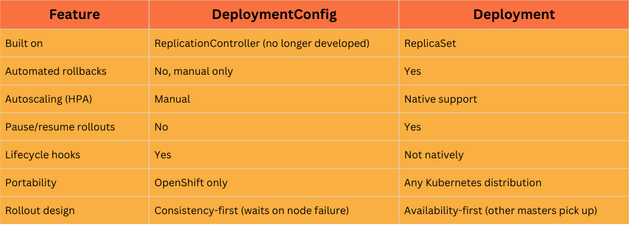
But Kubernetes caught up. Deployments now do automated rollbacks, HPA-based autoscaling, pause and resume during rollouts. And they’re built on ReplicaSets, not ReplicationControllers. That bit matters because ReplicationController development has stopped upstream entirely. The foundation DeploymentConfig sits on isn’t getting any love anymore.
There’s a design difference worth knowing about too. DeploymentConfig leans toward consistency: if the node running your deployer pod dies, it just waits. Waits for the node to recover, or for someone to manually step in. Deployments lean toward availability: the controller manager runs across multiple masters, so another one picks up the work. In production, you usually want that.
The other thing is portability. DeploymentConfigs only exist in OpenShift. Deployments are standard Kubernetes. If you ever need to move workloads between clusters or providers, that distinction starts to matter a lot.
And by sticking with DeploymentConfig, you’re also cutting yourself off from tooling. No Argo Rollouts for canary or blue-green. No native HPA. No automated rollback. Manual scaling, manual rollback. It’s fine until you’re doing it at 2am during an incident and wishing you weren’t.
Nobody’s flipping a switch on you tomorrow. DeploymentConfigs still run. But “it still works” isn’t really a strategy. If you haven’t started thinking about this, now’s a good time.
This article was adapted from Learn OpenShift.